Google AdX for Publishers: How to Get Access and What It Pays
 VisionForgeX Editorial TeamProgrammatic revenue specialists · Google MCM partner
On this page
- What is Google AdX?
- How an AdX auction decides your price
- Google AdX vs AdSense: what changes
- What Google AdX pays, and why it varies
- How to get Google AdX: three routes
- What Google checks before you can earn with AdX
- How to set up AdX so it actually earns
- Google AdX after the 2026 ad tech ruling
- How VisionForgeX runs AdX for publishers
- Frequently asked questions
Google AdX (Google Ad Exchange) is Google's real-time marketplace where advertisers, agencies and their buying platforms bid for each ad impression on your site. It runs inside Google Ad Manager, it is a first-price auction, and it reaches more buyers with more controls than AdSense. Most independent publishers get Google AdX through an approved MCM partner; large publishers can be invited directly by Google.
This guide explains how an AdX auction decides your price, how AdX differs from AdSense, what drives what it pays, the ways to get access, how to set it up so it earns, and what the 2026 court ruling on Google's ad tech means for you.
What is Google AdX?
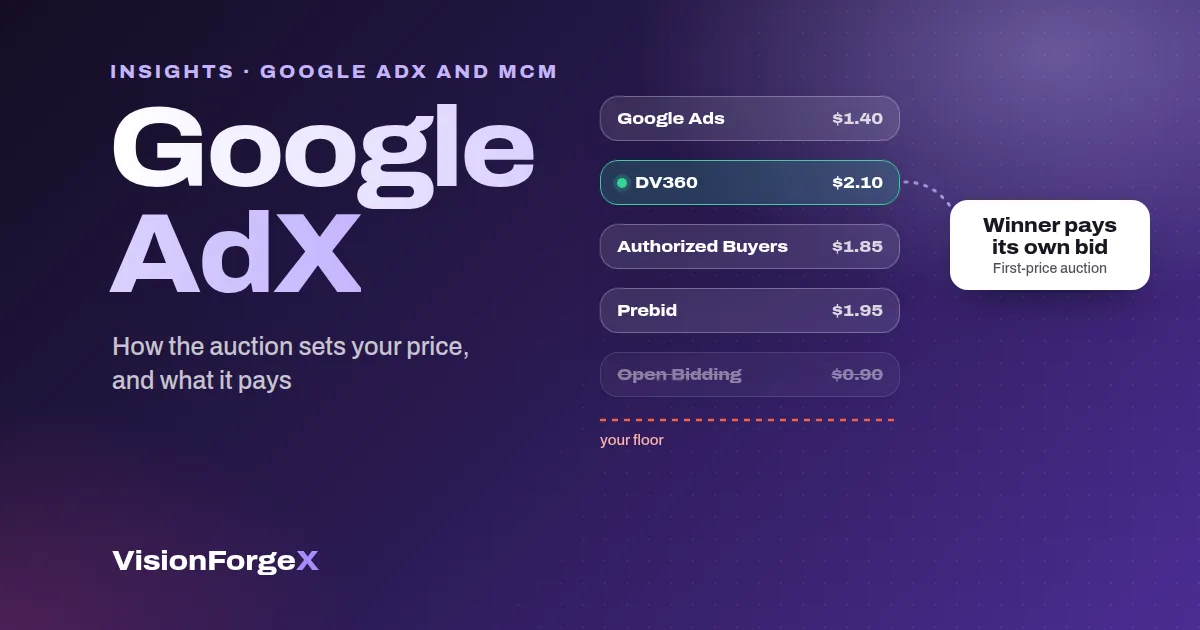
Google Ad Exchange is the exchange part of Google Ad Manager, Google's ad server for publishers. When a page loads, Ad Manager sends each ad slot to AdX, and AdX asks every eligible buyer for a bid in the fraction of a second before the ad shows.
The buyers that compete in AdX include:
- Google Ads and Display & Video 360 (DV360), Google's own buying tools for advertisers and agencies.
- Authorized Buyers: third-party buying platforms (DSPs) that bid on AdX directly.
- Open Bidding: other exchanges that Ad Manager lets into the same auction.
Because all of them compete for the same impression, the winning price is usually higher than when fewer buyers see it. That is the whole case for AdX: more competition per impression, plus controls (price floors, deals, brand blocking, detailed reports) that AdSense does not give you.
How an AdX auction decides your price
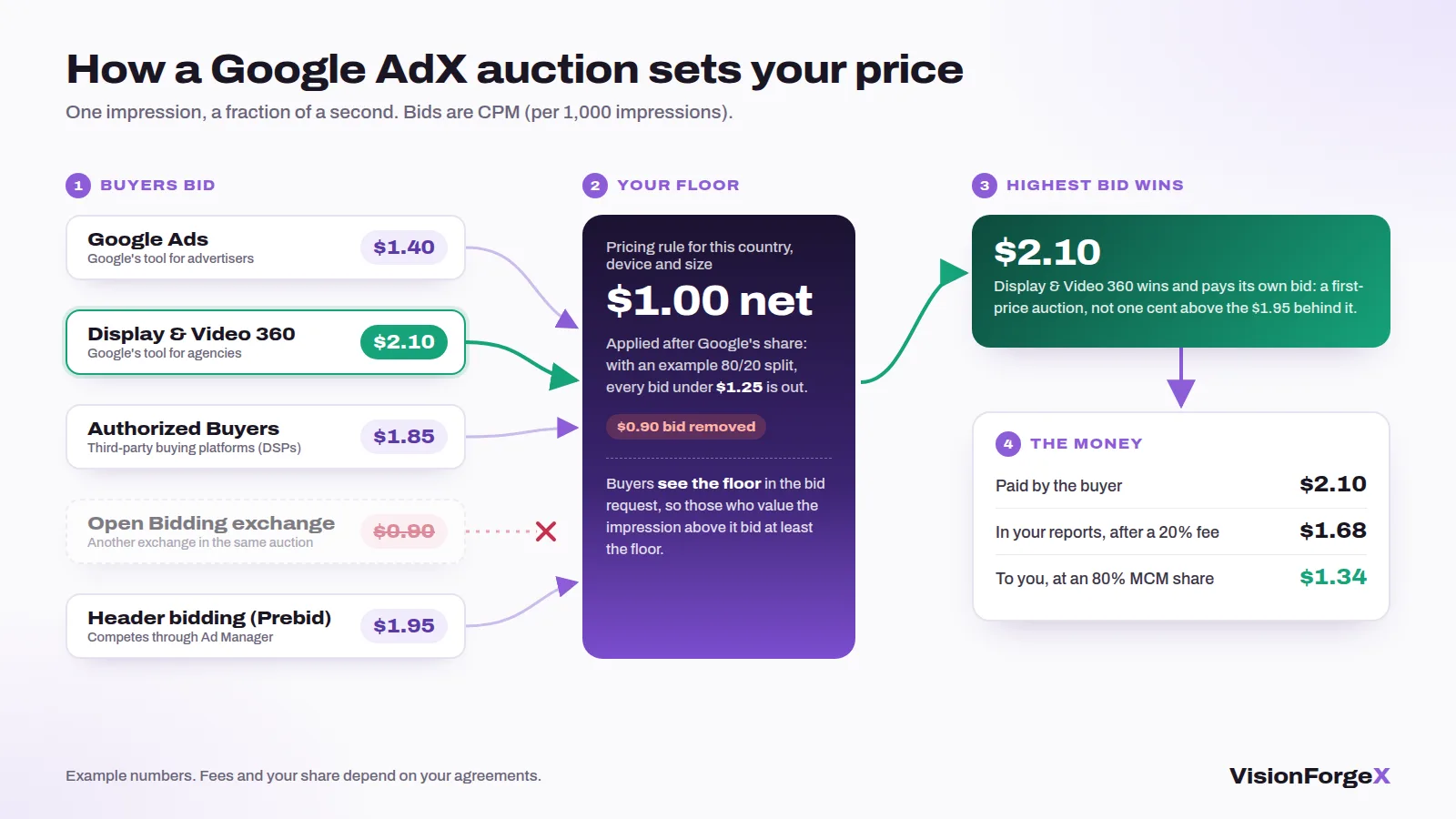
Since September 2019, Google Ad Manager runs a first-price auction: the winner pays what it bid, not one cent above the second-highest bid (Google Authorized Buyers announcement). In order:
- The page asks for an ad. Your ad tag sends the slot, its size, the page and the reader's country and device to Ad Manager.
- Buyers bid. Google Ads, DV360, Authorized Buyers and Open Bidding exchanges each answer with a price, or not at all.
- Your floors apply. A pricing rule (a "unified pricing rule" in Ad Manager) sets the lowest price you accept. Bids under it are thrown out.
- The highest bid wins and pays its own bid. If you run header bidding, its best bid competes in the same decision through Ad Manager.
- The money is split. Google's fee comes off first; the revenue in your reports is what is left. With an MCM partner, your agreed share of that is yours.
| How a Google AdX auction works: buyers bid, pricing rules remove bids under the floor, the highest bid wins and pays its own price, and the revenue is split after Google's fee]]
Two details in step 3 matter more than most publishers realise:
- Floors are net. Google applies pricing rules to "the value of a bid that would be paid to a publisher, after removing Google's revenue share" (Google Ad Manager Help). A floor of $1.00 on an 80/20 split blocks every bid under $1.25.
- Buyers see your floor. Ad Manager sends the floor in the bid request, so buyers who value the impression above it bid at least the floor instead of less.
That second point is why floors can earn money even in a first-price auction. We come back to it with numbers below.
Google AdX vs AdSense: what changes
AdSense and AdX sell to many of the same advertisers, but they are different products.
| AdSense | Google AdX | |
|---|---|---|
| Who can join | Almost any site that meets Google's policies | By invitation from Google, or through an MCM partner |
| Buyers | Google Ads, DV360 and some third-party buyers, chosen by Google | The same buyers, plus Open Bidding exchanges and deals you agree with advertisers |
| Price floors | No real control | Pricing rules per ad unit, country, device, size and more |
| Deals with advertisers | No | Private auctions, preferred deals, programmatic guaranteed |
| Works with header bidding | No | Yes, inside Ad Manager |
| Reports | Basic | Detailed, by country, device, size, buyer, deal and bid range |
| Revenue share | Publisher receives 80% after the advertiser platform's fee (Google) | Set in your Ad Manager or MCM partner agreement |
| Effort | Paste a code and wait | Needs setup and ongoing optimization |
AdSense is the easy door. AdX is the bigger room, and what you earn in it depends on how well the room is run: which formats, which floors, which other demand competes alongside it.
What Google AdX pays, and why it varies
There is no honest single number for AdX revenue. Anyone quoting "AdX pays 3x AdSense" for every site is selling something. What you can say with confidence is which levers move it.
1. How many buyers want the same impression. In a first-price auction, buyers bid only a little above what they expect to have to beat, not what the impression is worth to them. Where few buyers compete, bids sit far below their true value; where many compete, the price is pushed up close to it. This is the single biggest reason two sites with the same traffic earn very different amounts.
2. Who the reader is. Country, device and time of year. Readers in the United States, United Kingdom, Canada and Australia attract more advertisers than most other countries, and every year Q4 pays more and January less, because that is when advertisers spend.
3. Whether the ad is seen. Buyers pay for ads that are viewed. A unit low on the page that few readers scroll to earns much less than one in the article that stays on screen.
4. Your floors. Set too low, they do nothing. Set too high, they throw sales away. Set per country, device and size where competition is thin, they lift prices.
5. Your share. Google says that in 2019, publishers using Ad Manager kept over 69 percent of what advertisers paid through Google Ads and DV360 (Google). With an MCM partner, your agreed share comes off what is left, so always ask which figure it is calculated on.
When a floor helps: a worked example
The table below comes from the model behind the VisionForgeX Floor advisor, run on the same spread of bids six times with only one thing changed: how many buyers compete for each impression. It shows how far below their true value buyers bid, and what the best "Balanced" floor would add.
| Buyers per impression | Bids as a share of what buyers would pay | Best floor, as a share of eCPM | Expected revenue added by that floor |
|---|---|---|---|
| 1.5 | 44% | 40% | +9.8% |
| 2 | 51% | 42% | +5.9% |
| 3 | 61% | 42% | +2.0% |
| 4 | 68% | 29% | +0.8% |
| 6 | 76% | No floor pays | 0% |
| 8 | 81% | No floor pays | 0% |
Model results on simulated bids, not figures from a real site. The Floor advisor runs the same model on each site's own Ad Manager bids, country by country, and measures every floor after it goes live.
The lesson is practical: floors earn the most where competition is thinnest, which is often the traffic publishers ignore (smaller countries, odd ad sizes, tablets). On busy, competitive traffic, the market already sets the price and a floor mostly costs fill. A single floor across a whole site is almost always wrong in both directions.
How to get Google AdX: three routes
| Route | Who it suits | What it takes |
|---|---|---|
| Directly from Google | Large publishers and media groups | An Ad Manager account and an invitation or approval from Google. Google does not publish a traffic threshold. Often comes with Ad Manager 360, Google's paid tier |
| Through an MCM partner | Most independent publishers, blogs and niche sites | Accept a partner's invitation from your existing Google account; Google reviews you; the partner's tags and ads.txt lines go on your site |
| Through someone else's network, without MCM | Nobody | Selling your inventory under another publisher's account breaks Google's rules. If a partner cannot show you an MCM invitation, walk away |
For the second route, our guide to Google MCM explains the two setups (Manage Inventory and Manage Account), who gets paid and when, and the ten questions to ask a partner before you accept.
What Google checks before you can earn with AdX
Whichever route you take, Google looks at the same things:
- Original content you own, in a language Google supports, on a site that is finished and maintained.
- Google's publisher policies. No copyrighted material you don't have rights to, nothing in restricted categories without the right settings, and ad placements that do not mislead readers or crowd the content.
- Clean traffic. Bought traffic, click exchanges, auto-refreshing pages and bots lead to deductions first and closed accounts later.
- One account per publisher, verified identity, and (for payments) a verified address.
- A correct ads.txt file listing every seller you authorise, so buyers trust your inventory. Without it, many buyers bid lower or not at all.
Google finalises each month's earnings in the first week of the next month and pays later that month once you pass the payment threshold (Google Ad Manager Help). Through an MCM partner, the partner's own payment terms decide when the money reaches you.
How to set up AdX so it actually earns
Getting AdX is the start. These are the settings that decide what it pays, in the order we work through them on a new site:
- ads.txt first. Add every line your partner gives you, exactly as given, and check it again after any site migration. A broken ads.txt silently costs more than any floor can win back.
- Ad units that are seen. One unit after the second paragraph, one mid-article, one near the end, a sticky anchor on mobile and side rails on wide desktop screens earn more than a crowded header. Keep layouts inside Google's rules: no ads squeezed against buttons or menus.
- The sizes buyers bid on. Let each slot accept the common sizes that fit it (300x250 and 336x280 in articles, 728x90 or 970x90 on desktop, 320x50 or 320x100 anchors on mobile). More eligible sizes means more bidders per impression.
- Header bidding alongside AdX. Prebid bidders compete with AdX in the same decision in Ad Manager. More buyers per impression is the strongest lever in the table above.
- Floors per country, device and size, never one site-wide floor. Start careful, measure each against the same traffic's numbers before it went live, and raise it only while revenue per 1,000 ad requests rises.
- Page speed. Load ads lazily as the reader scrolls and reserve space for each slot, so ads do not push the content around (Core Web Vitals) or slow the page that earns them.
- Watch invalid traffic. Filter obvious bots before they reach the auction; Google deducts invalid activity from earnings, sometimes months later.
Google AdX after the 2026 ad tech ruling
In April 2025, a US federal court found that Google illegally monopolised the markets for publisher ad servers and ad exchanges. On 2 September 2026, Judge Leonie Brinkema declined to order Google to sell AdX, and instead ordered behavioural remedies (AdExchanger). Reported remedies include integrating Google's ad server and AdX with Prebid, letting publishers export their own data, and six years of oversight by a compliance monitor (Goodwin). Google has said it will appeal the original ruling.
What this means for a publisher today:
- Nothing to do right now. AdX and Ad Manager keep working as they are.
- Watch for AdX in Prebid. If AdX demand becomes available through Prebid, header bidding setups could compete with it more directly.
- Watch how floors change. Google proposed replacing unified pricing rules with floors that can differ per bidder. If that is adopted, floor strategy gets more precise and more important.
The exact obligations depend on the final judgment, so treat any vendor promising specific changes before then with care. We will update this section as the details are confirmed.
How VisionForgeX runs AdX for publishers
VisionForgeX is a Google MCM partner. For publishers in our network, AdX comes with the tools this guide describes, built into one dashboard:
- Floor advisor: floors per site, country, device and size from your own Ad Manager bids, at the risk level you choose, measured every day after they go live.
- Header bidding alongside AdX, so more buyers compete for every impression.
- Policy protection: layout checks against Google's placement rules, invalid-traffic filtering and a watch on your MCM and policy status.
- Transparent reporting and payments: your numbers by day, site and format, every deduction shown with its reason, and payment by bank wire, PayPal, Payoneer or USDT.
If you want to know what your traffic could earn through AdX, send us your site or book a call. Every article on Google AdX and MCM is collected on the Google AdX and MCM topic page.
Frequently asked questions
What is the difference between Google AdX and Google Ad Manager?
Google Ad Manager is the ad server: it decides which ad shows in each slot, from direct campaigns, header bidding and exchanges. Google AdX is the exchange inside it, where buyers bid in real time. You use AdX through Ad Manager, either your own or an MCM partner's.
Is Google AdX better than AdSense?
For most sites with steady traffic, AdX earns more because more buyers compete and you control floors, formats and deals. It also needs more setup and someone to run it well. For a brand-new or very small site, AdSense is the simpler start.
How much traffic do I need for Google AdX?
Google does not publish a minimum. Direct access is usually for large publishers; MCM partners set their own requirements, often based on traffic quality and content more than raw page views. Original content, clean traffic and policy compliance matter more than a number.
Is Google AdX a first-price auction?
Yes. Since September 2019, Google Ad Manager runs a first-price auction: the winning buyer pays its own bid. That is why buyers shade their bids, and why well-placed floors can raise the price.
Can I use AdX and header bidding together?
Yes, and you should. Prebid bids enter Ad Manager as line items and compete with AdX for each impression, so the highest price wins whichever side it comes from.
Does Google AdX pay monthly?
Google finalises earnings in the first week after each month ends and pays during that month once you pass the payment threshold. Through an MCM partner, you are paid on the partner's schedule, usually 30 to 60 days after the month ends.
Written by
VisionForgeX Editorial Team
Programmatic revenue specialists · Google MCM partner
The VisionForgeX team runs Google Ad Exchange, header bidding and OpenRTB auctions for publishers every day. Every article is written from that work and checked against live data before it is published.
- Google Ad Manager and Ad Exchange (MCM) operations
- Prebid.js and OpenRTB integrations
- Revenue optimization across thousands of publisher pages
Read next
More on Google AdX and MCM → Google AdX and MCM
What Is Google MCM? How It Works and How to Choose a Partner
Google MCM explained: how Multiple Customer Management gets publishers into Google AdX, Manage Inventory vs Manage Account, payments and choosing a partner.
 Google AdX and MCM
Ad Manager reporting delay: why today's numbers look low
Today's Ad Manager numbers are always partial, and yesterday's can still move. What Google says about how fresh the data is, the time zone trap, and a small script that compares today with the same hours of yesterday.
 Google AdX and MCM
Google Ad Manager key values: set up, send and report on them
Key-values tell Ad Manager what a page is about, so a line item can target it and a report can split by it. How to create the key, send values from the page, stay inside Google's limits, and avoid the trap of values nobody can report on.